
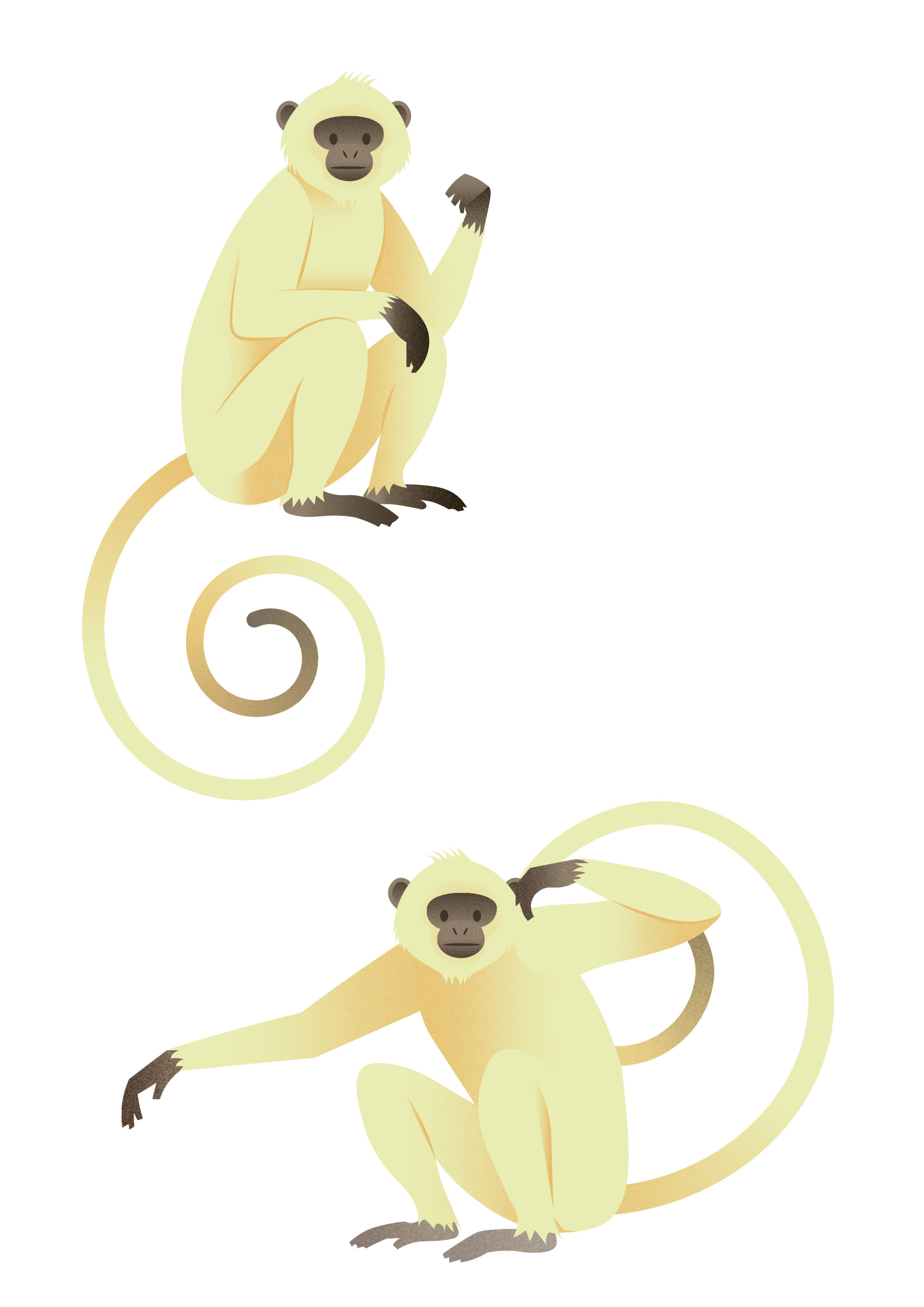
“Why aliens?” you might be asking yourselves.
Who is Hanuman? From today’s perspective, aren’t the wondrous beings of Indian mythology essentially aliens, and doesn’t reading about them challenge our ideas of the world order and attitudes toward social, religious, and spiritual issues? Aren’t they incredibly relevant today—these devas, demons, and divine beings? These were the questions I grappled with while writing.
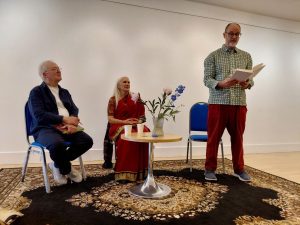
The answers came during the delightful book launch in West London—exactly there, where I began studying Indian dance at the age of 20. The audience was acquainted with Indian mythology and with living across continents. Simply put, London is the gateway to the global world, in Continental Europe it is sometimes seen merely as a gateway to the exotic.
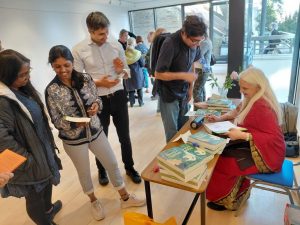
I absolutely loved presenting my revised book in London. And I was lucky to meet these people in England who supported me. First and foremost, Diana Chambers, who accompanied me every step of the way for nearly three years as I reorganized and rewrote the English version—and she did it for free. Her reward, she said, was the book’s publication. That moment has now arrived for her, and we celebrated. Shared work and shared joy are truly great. I was also supported at the reading by theater director Jonathan Chadwick. He was one of the enthusiastic first readers and immediately agreed to help present the book and make the launch interesting by asking me questions. Carl Hargreaves read aloud in his beautiful voice. Since the book’s first-person narrator is male, it felt authentic to hear him read it. Both were so spontaneous and, once again, participated without compensation. Then there were friends like Janet, who spread the word and organized a good group of female supporters for this launch. The audience, however, was very diverse—young and old, women and men, and those who don’t fit neatly into such categories. For me, a lifelong dream came true—to return, artistically, to the place where my sense of being different and my immersion in other ways of thinking began.
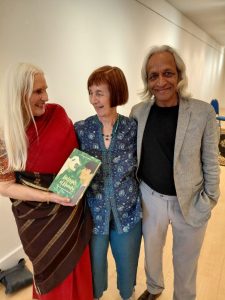 With Diana Chambers
Added to this was the sheer joy that the printing, the design (by Clemens Maurer), and the typesetting are all of the highest quality, and that Motilal—the 120-year-old Indian publishing house of great renown—truly lived up to our expectations.
Now comes the distribution of *Footprints of Eternity – Ramayana Reimagined*. You can now pre-order the book from Motilal or via Amazon in countries outside India. However, it is possible to quickly obtain the book from my inventory in England and Germany through my website, which will be relaunched in the coming days. I’d be most happy if you’d post your comments on this page, which is being designed for the book, and help bring it to life.
Footprints of Eternity is a book that examines sensuality, eroticism, colonial thinking, environmental policy, and the doubts and fears of modernity, offering answers through essential and poetic excerpts from the Ramayana that echo the main narrative. Unfortunately, the Ramayana is not very known in Germany, while it is required reading in schools in England. The Ramayana is particularly underappreciated in the local yoga scene. Hanuman is the yogi who has attained the goals (the siddhis) of yoga. He is a key figure in understanding the background of the yoga path.
Jonathan particularly liked the way I described the women whom Govinda, my protagonist, loves. They all possess a natural self-confidence as women; they all live in the goddess Sita.
I am reminded of the Dedication, ‘…she who lets the man triumph and smiles as she does so’ (from *Lotosblüten Öffnen Sich *, my first book).
That’s the direction feminism should take—assume a new role and fight for key positions on supervisory boards, for example in industry.
My grandson was especially touching. He shared in my joy, and what makes it special is that the Ramayana is told by Paati, the protagonist’s eccentric grandmother, in her lively, witty way.

Enjoy reading it.